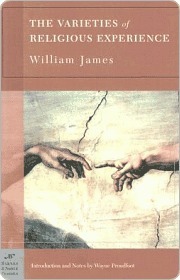
The book was published in 1902 and was based on lectures that James gave in 1901-02 at the University of Edinburgh. No doubt the lectures were crafted for students of psychology at the university. They seem designed to emphasize the erudition of the lecturer who never uses one word when twenty will suffice and never uses a single syllable word if one with multiple syllables is available. The author also quotes extensively from other writers. Sometimes these quotes go on for pages, as do many of the footnotes. I think I am a fairly patient reader but my strong impulse here was to say, "Just get on with it! Say what you mean and let it stand. Stop beating around the bushes."
And yet I must report that this book was a best seller in its day. Apparently, excessive wordiness was just what the readers of the day wanted. The winter nights were long and sources of entertainment were limited. Of course, there's no way of knowing whether buyers of the book actually READ it or if it was a vanity purchase.
Now, as to the title of the book, in my opinion, it should have been The Varieties of Christian Experience because that's really all he discusses. Mentions of any other religious faiths are merely done in passing. The writer evidently wished to stick to the religious beliefs of which he had personal experience, but it does cause one to wonder just how much he really knew about those other faiths. It could be argued that the Christian experience is easily extrapolated to other systems of belief, but I'm not entirely sure that is true and it certainly is not supported by this text.
James' primary focus is even narrower than that. He makes the distinction between Catholic and Protestant forms of Christianity and, in his considered opinion, the Protestant form is superior. Thus, the Protestant experience seems to me to be what his book is really about.
The writer's plan for the book was to explore individual rather than group experiences of religion. The examples that he uses to illustrate his points are almost never of ordinary people for whom one might be able to have some fellow feeling; they are stories of mystics and saints and of extreme born-again converts, all of whose experiences seemed occasionally interesting but rather foreign to me. Are the extremes of experience truly the best way to discuss the subject? That's debatable, I think, but again, James was writing for the audience of his day, not for me, and evidently, that audience lapped it up.
James' conclusion is that religious feelings are a good thing, a force for good in society, even though he himself says that such feelings are not a part of his personal experience. Perhaps that explains in part why he chose such bizarre cases to support his arguments.
My conclusion about his book is that it is an extremely frustrating and annoying read. It could have been one-half its length and that probably would have made it a better book. I've seen raves about what a talented and insightful writer James was, but I did not find this particularly insightful or well-written. It may well have pleased the readers of the early twentieth century; this reader of the twenty-first century not so much.
My rating: 2 of 5 stars
I don't think I'll be reading this particular book any time soon. Although I am a fan of the books of Henry James, his brother. :)
ReplyDeleteHenry could be pretty wordy, too. I guess it was the writing style of that era. But Henry's words seemed a bit better thought out and to the point.
DeleteI think I will pass!
ReplyDeleteProbably a wise decision.
DeleteOh no...all the effort you but into this one. Sorry to read it was so disappointing.
ReplyDeleteIt's considered a classic and was evidently very popular in its day, but obviously it was written for a very different audience than today's readers.
DeleteOh boy. you are a patient reader! I don't think I could have read this book if the author used way too many words when fewer words could have been used instead... And the quotes that go on forever, oh brother!! Need I say more?
ReplyDeleteI'm actually glad that I read it because I had heard so much about it and had long been curious about it, but, yes, reading it was definitely a chore.
Deletei must say, it's awfully brave of you to tackle WJ... and to provide a comprehensible and elegant description of the book afterwards. i think his reputation as a genius has kept me from reading him; that and the fact that he's pretty turgid... anyway, tx and congrats!
ReplyDeleteI feel like I've run a reading marathon.
DeleteAs much as I loved Henry James' Turn of the Screw, I thought I'd never finish The Ambassadors, wordy doesn't even begin to define it. My admiration for taking on William's The Varieties of Religious Experience, it sounds agonizing.
ReplyDeleteMaybe authors of the period were paid by the word. At any rate, they seemed to take some pride in being able use lots and lots of words.
DeleteI hope you will think of your read as a mission-of-mercy for those of us, like me, who have often contemplated reading this book, but who now, thanks to your review, will strike this book from their lists. Thank you, thank you, thank you. Life is too short.
ReplyDeleteSo glad I could be of service!
DeleteWhat you just accomplished, in my opinion as a fellow reader, was heroic. Seriously.
ReplyDeleteWhy, thank you, Sam.
DeleteWell, I'm really glad I read your review! I know to stay far away from this one!
ReplyDeleteIt seems that "classics" from another age do not always travel well through time.
Delete