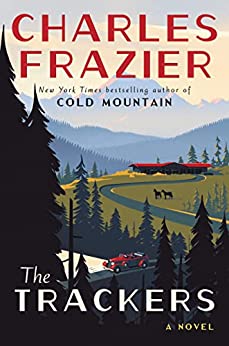
The Trackers by Charles Frazier: A review

This book is set during the Great Depression of the 1930s. It's not really an era that I prefer reading about, maybe because I grew up with parents who had lived through it and my life was informed by their stories of it. I have somewhat the same prejudice about World War II. It was the defining event of my father's life and I heard about it all during my childhood. But setting my prejudices aside, I had enjoyed Charles Frazier's Cold Mountain, so I decided to give his new book a chance. I'm glad I did. It was an enjoyable read.

It tells the story of a painter, Val Welch, who secures a New Deal assignment to paint a mural in the Dawes, Wyoming post office. The mural is supposed to represent a vision of that region of the world. Val considers himself very lucky to have landed the job when so many are out of work.

He travels west to Dawes prepared to get busy with the project. A wealthy rancher, John Long, and his wife, Eve, have invited Dawes to stay in one of the bunkhouses that serve the cowboys who work for them. He settles in and starts planning his work.

The Longs are the subject of a lot of gossip in the town. John has hopes for a political career. He had served in the army in World War I, but that service seems a bit shady in that he was a sniper. Rather than facing the enemy head-on, he killed while hidden. It's not clear how that will play in the rough tumble of a political campaign.

Moreover, his wife is a bit of a question mark. Before marrying John, she had lived the itinerant life of a singer in a Western swing band and she seems to be loathe to settling down to life as a rancher's wife. In fact, she doesn't settle. One day she absconds taking with her a valuable painting. Her husband hires the mural painter, Val, to go after her, find her, and bring her home.

Val travels across the continent in his search for Eve. Through his eyes, we see the ramshackle settlements that were called Hoovervilles that sprang up around the country. We also experience the nightlife of San Francisco in that era and finally, we travel to the swamps of Florida. 

Charles Frazier has done his research well and he brings all of that to life for us and makes the reader feel the desperation of the period. He does have a knack for writing about ordinary people who are just trying to get through the day and then tomorrow and the next day and the next... 

And that is exactly the story he has given us with The Trackers.

Comments

  1. Interesting plot. I like Frazier generally because of his characters but sometimes I get bogged down in his prose style that begins to feel a little "dense" to me at times.

    ReplyDelete
  2. I've never read any of Frazier's books. I started Cold Mountain once, but just couldn't get into it. I don't know if it was the writing or just my mood. Parts of this one intrigue me, but I'm not sure I'd get through it right now either.

    ReplyDelete
    Replies
    1. I'm not really enamored of his style of writing but he does tell some good stories.

      Delete
  3. Oh good. I'm glad you read & reviewed this novel. After his novels Cold Mountain and Varina, I am a Frazier fan. But I think the critics response steered me away from this new one ... But now I plan to put it back on my TBR due to your positive thoughts. Have you read Varina? I liked that one. Which is your favorite Frazier novel? hmm

    ReplyDelete
    Replies
    1. The only ones of his that I've read are "Cold Mountain" and this one and I've liked them both about equally. I'll put "Varina" on my reading list.

      Delete

Post a Comment

Popular posts from this blog

Poetry Sunday: Don't Hesitate by Mary Oliver

How about we share another Mary Oliver poem? After all, you can never have too many of those. In this one, the poet seems to acknowledge that it is often hard to simply live in and enjoy the moment, perhaps because we are afraid it can't last. She urges us to give in to that moment and fully experience the joy. Although "much can never be redeemed, still, life has some possibility left." Don't Hesitate by Mary Oliver If you suddenly and unexpectedly feel joy, don’t hesitate. Give in to it. There are plenty of lives and whole towns destroyed or about to be. We are not wise, and not very often kind. And much can never be redeemed. Still, life has some possibility left. Perhaps this is its way of fighting back, that sometimes something happens better than all the riches or power in the world. It could be anything, but very likely you notice it in the instant when love begins. Anyway, that’s often the case. Anyway, whatever it is, don’t be afraid of its plenty. Joy is no...

Poetry Sunday: Blackberry-Picking by Seamus Heaney

My mother was a farm wife and a prodigious canner. She canned fruit and vegetables from the garden, even occasionally meat. But the best thing that she canned, in my opinion, was blackberry jam. Even as I type those words my mouth waters!  Of course, before she could make that jam, somebody had to pick the blackberries. And that somebody was quite often named Dorothy. I think Seamus Heaney might have spent some time among the briars plucking those delicious black fruits as well, so he would have known that "Once off the bush the fruit fermented, the sweet flesh would turn sour." They don't keep; you have to get that jam made in a hurry! Blackberry-Picking by Seamus Heaney Late August, given heavy rain and sun For a full week, the blackberries would ripen. At first, just one, a glossy purple clot Among others, red, green, hard as a knot. You ate that first one and its flesh was sweet Like thickened wine: summer's blood was in it Leaving stains upon the tongue and lust ...

Poetry Sunday: Hymn for the Hurting by Amanda Gorman

You probably remember poet Amanda Gorman from her appearance at the inauguration of President Biden. She read her poem "The Hill We Climb" on that occasion. After the senseless slaughter in Uvalde this week, she was inspired to write another poem which was published in The New York Times. It seemed perfect for the occasion and so I stole it in order to feature it here, just in case you didn't get a chance to read it in the Times . Hymn for the Hurting by Amanda Gorman Everything hurts, Our hearts shadowed and strange, Minds made muddied and mute. We carry tragedy, terrifying and true. And yet none of it is new; We knew it as home, As horror, As heritage. Even our children Cannot be children, Cannot be. Everything hurts. It’s a hard time to be alive, And even harder to stay that way. We’re burdened to live out these days, While at the same time, blessed to outlive them. This alarm is how we know We must be altered — That we must differ or die, That we must triumph or try. ...