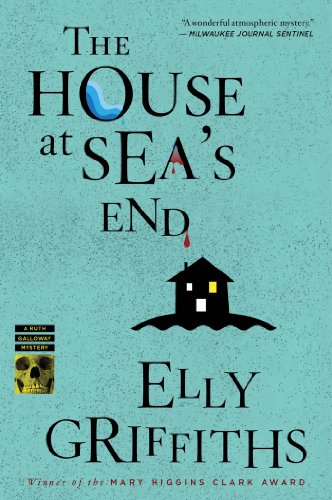
The House at Sea's End by Elly Griffiths


I am thoroughly enjoying Elly Griffiths' series featuring forensic archaeologist Dr. Ruth Galloway. My enjoyment is mostly related to the character of Dr. Galloway. She is a single middle-aged woman, the type of character that in many books would be portrayed as waiting and wishing for that special man to come along and complete their life. Not Ruth Galloway! She's much too busy digging up and interpreting the remains of the past. She is living the life she always dreamed of. 

This is the third entry in the series and in it, we find that Ruth has just given birth to her daughter, Kate, and she is struggling with the difficulties of juggling motherhood and work. 

When human bones surface on a remote Norfolk beach, Ruth is called in to investigate. This necessarily brings her back into contact with DCI Harry Nelson, the married father of her daughter. Awkward? To say the least!

The bones turn out to be around seventy years old bringing an association with the World War II era. But meanwhile, Ruth has been brought in to supervise the opening of a coffin that has been excavated near a medieval church. When she arrives on site she finds the museum's curator, Neil Topham, lying dead beside the coffin. And, of course, DCI Nelson is brought in to investigate the case. So Ruth is once again embroiled in a murder case alongside DCI Nelson.

There have been other spooky incidents recently and there is a suspicion that they are the work of a group called the Elginists, the goal of which is to repatriate the museum's extensive collection of Aboriginal skulls. Among the unexpected incidents has been the untimely death of the museum's owner, Lord Smith.

In addition to Ruth and Nelson, all the usual secondary characters are on hand for this one, including the sort of druid, Cathbad. In fact, Cathbad might be my favorite character in the series along with Ruth's cat, Flint. Those two are full of personality and it would be a much duller series without them.  


Comments

  1. I think she ended the series and I can't wait to read the last book which should have the final results of her romance with the detective.

    ReplyDelete
    Replies
    1. I'm looking forward to reading the next book in the series.

      Delete
  2. Ruth Galloway is a strong female character. I like her. I really like Cathbad, too. And I thought this was a good one, though I can't remember too much about it now. ;D

    ReplyDelete
    Replies
    1. I know what you mean. When you are a constant reader as I am and I suspect you are, the plots sometimes tend to sort of run together over time.

      Delete
  3. You have been reading a lot of mysteries lately, Dorothy. I'm glad to hear your always-wise thoughts about the various series that are out there.

    ReplyDelete
    Replies
    1. I guess I have been in a "mysterious" mood lately. Thanks for the compliment, although I am not sure how wise my thoughts are. However, I can guarantee that they are always my honest reactions.

      Delete
  4. You're starting to hook me with these Ruth Galloway books which sound very entertaining. The author seems prolific and these ones would make a good series I think.

    ReplyDelete
    Replies
    1. They are well-written and I find the characters relatable. I'm looking forward to reading more of them.

      Delete

Post a Comment

Popular posts from this blog

Poetry Sunday: Don't Hesitate by Mary Oliver

How about we share another Mary Oliver poem? After all, you can never have too many of those. In this one, the poet seems to acknowledge that it is often hard to simply live in and enjoy the moment, perhaps because we are afraid it can't last. She urges us to give in to that moment and fully experience the joy. Although "much can never be redeemed, still, life has some possibility left." Don't Hesitate by Mary Oliver If you suddenly and unexpectedly feel joy, don’t hesitate. Give in to it. There are plenty of lives and whole towns destroyed or about to be. We are not wise, and not very often kind. And much can never be redeemed. Still, life has some possibility left. Perhaps this is its way of fighting back, that sometimes something happens better than all the riches or power in the world. It could be anything, but very likely you notice it in the instant when love begins. Anyway, that’s often the case. Anyway, whatever it is, don’t be afraid of its plenty. Joy is no...

Poetry Sunday: Blackberry-Picking by Seamus Heaney

My mother was a farm wife and a prodigious canner. She canned fruit and vegetables from the garden, even occasionally meat. But the best thing that she canned, in my opinion, was blackberry jam. Even as I type those words my mouth waters!  Of course, before she could make that jam, somebody had to pick the blackberries. And that somebody was quite often named Dorothy. I think Seamus Heaney might have spent some time among the briars plucking those delicious black fruits as well, so he would have known that "Once off the bush the fruit fermented, the sweet flesh would turn sour." They don't keep; you have to get that jam made in a hurry! Blackberry-Picking by Seamus Heaney Late August, given heavy rain and sun For a full week, the blackberries would ripen. At first, just one, a glossy purple clot Among others, red, green, hard as a knot. You ate that first one and its flesh was sweet Like thickened wine: summer's blood was in it Leaving stains upon the tongue and lust ...

Poetry Sunday: Hymn for the Hurting by Amanda Gorman

You probably remember poet Amanda Gorman from her appearance at the inauguration of President Biden. She read her poem "The Hill We Climb" on that occasion. After the senseless slaughter in Uvalde this week, she was inspired to write another poem which was published in The New York Times. It seemed perfect for the occasion and so I stole it in order to feature it here, just in case you didn't get a chance to read it in the Times . Hymn for the Hurting by Amanda Gorman Everything hurts, Our hearts shadowed and strange, Minds made muddied and mute. We carry tragedy, terrifying and true. And yet none of it is new; We knew it as home, As horror, As heritage. Even our children Cannot be children, Cannot be. Everything hurts. It’s a hard time to be alive, And even harder to stay that way. We’re burdened to live out these days, While at the same time, blessed to outlive them. This alarm is how we know We must be altered — That we must differ or die, That we must triumph or try. ...