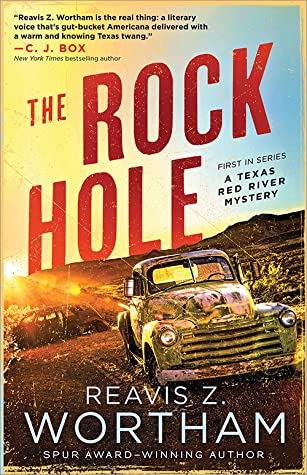
The Rock Hole by Reavis Z. Wortham: A review

I had read a couple of the later entries in this series and decided that perhaps I should go back to the beginning. This book was the first in the Red River mysteries series.

The events of the book take place in 1964 in East Texas, a time and place when racial tensions were a prominent part of everyday life. We meet Constable Ned Parker who is White and a Black deputy sheriff named John Washington. The two work together to deliver justice and to protect their community from evil.

In this case, this evil is exemplified by an individual who takes pleasure in torturing and killing animals. Of course, he doesn't stop there. He soon moves on to humans and the killer seems to be targeting the constable's family which includes his ten-year-old grandson Top who is now living with him after the death of his parents in a car crash. The story of the investigation is told mostly through the perspective of Top and his slightly older cousin, Pepper.

This is very different from the kinds of cases which the constable normally handles. He's used to dealing with drunks and moonshiners and the occasional domestic disturbance. This is an entirely different level of evil.

Woven in among the pursuit of the evil-doer is the story of the coming-of-age of Top and Pepper. Thus we get the contrast of their sweet innocence with the pure wickedness of which humans are capable.

Perhaps the strongest part of the story for me was the author's description of the setting. I'm pretty familiar with small East Texas towns and I found his descriptions of the culture of those places to be spot on. Moreover, the characters as he described them fit right into that setting. It's a community that is replete with small-town Western values, where everyone knows everyone and neighbors will look out for their neighbors. While the writer does tend to somewhat gloss over the racial tensions of that era, I think he gets the overall atmosphere pretty much right. And his characters are people that the reader can identify with and care about. This was a good start for the series and it left me wanting to read more about these people.

Comments

  1. This sounds like my type of book! Thank you. P. x

    ReplyDelete
  2. I've enjoyed this series, and in many ways I regret that Wortham seems to have moved on from it. I agree that the setting is the real strength in the books, and what surprised me is how similar small East Texas towns at that time were to small central Illinois towns (which is where I grew up).

    ReplyDelete
    Replies
    1. I didn't realize the author had moved on from it. That seems a shame. There is plenty of material there.

      Delete

Post a Comment

Popular posts from this blog

Poetry Sunday: Don't Hesitate by Mary Oliver

How about we share another Mary Oliver poem? After all, you can never have too many of those. In this one, the poet seems to acknowledge that it is often hard to simply live in and enjoy the moment, perhaps because we are afraid it can't last. She urges us to give in to that moment and fully experience the joy. Although "much can never be redeemed, still, life has some possibility left." Don't Hesitate by Mary Oliver If you suddenly and unexpectedly feel joy, don’t hesitate. Give in to it. There are plenty of lives and whole towns destroyed or about to be. We are not wise, and not very often kind. And much can never be redeemed. Still, life has some possibility left. Perhaps this is its way of fighting back, that sometimes something happens better than all the riches or power in the world. It could be anything, but very likely you notice it in the instant when love begins. Anyway, that’s often the case. Anyway, whatever it is, don’t be afraid of its plenty. Joy is no...

Poetry Sunday: Blackberry-Picking by Seamus Heaney

My mother was a farm wife and a prodigious canner. She canned fruit and vegetables from the garden, even occasionally meat. But the best thing that she canned, in my opinion, was blackberry jam. Even as I type those words my mouth waters!  Of course, before she could make that jam, somebody had to pick the blackberries. And that somebody was quite often named Dorothy. I think Seamus Heaney might have spent some time among the briars plucking those delicious black fruits as well, so he would have known that "Once off the bush the fruit fermented, the sweet flesh would turn sour." They don't keep; you have to get that jam made in a hurry! Blackberry-Picking by Seamus Heaney Late August, given heavy rain and sun For a full week, the blackberries would ripen. At first, just one, a glossy purple clot Among others, red, green, hard as a knot. You ate that first one and its flesh was sweet Like thickened wine: summer's blood was in it Leaving stains upon the tongue and lust ...

Poetry Sunday: Hymn for the Hurting by Amanda Gorman

You probably remember poet Amanda Gorman from her appearance at the inauguration of President Biden. She read her poem "The Hill We Climb" on that occasion. After the senseless slaughter in Uvalde this week, she was inspired to write another poem which was published in The New York Times. It seemed perfect for the occasion and so I stole it in order to feature it here, just in case you didn't get a chance to read it in the Times . Hymn for the Hurting by Amanda Gorman Everything hurts, Our hearts shadowed and strange, Minds made muddied and mute. We carry tragedy, terrifying and true. And yet none of it is new; We knew it as home, As horror, As heritage. Even our children Cannot be children, Cannot be. Everything hurts. It’s a hard time to be alive, And even harder to stay that way. We’re burdened to live out these days, While at the same time, blessed to outlive them. This alarm is how we know We must be altered — That we must differ or die, That we must triumph or try. ...