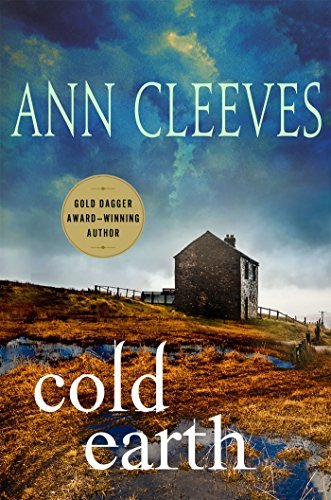
Cold Earth by Ann Cleeves: A review


Ann Cleeves' series set in the Shetland Islands is truly one of my favorite mystery reads. In Cold Earth, the original mystery is the identity of a woman found dead after a landslide that sends a house and part of a cemetery slipping down a hill into the North Sea. It soon becomes clear, however, that it was not the storm or the landslide that killed her. No, her death was caused by a human, not by Nature. She was strangled.

The landslide comes during a funeral. Jimmy Perez is present for the burial of his old friend, Magnus Tait, and he watches in horror as the flood of mud and peaty water smashes through a croft house in its path. The house was believed to be unoccupied but when he searches the wreckage he finds the body of a dark-haired woman wearing a red silk dress.

There is no identification on the body and the only possible clue to her identity is a wooden box containing two pictures, one of two small children and one of an elderly couple. There is also a handwritten letter that begins: "My dearest Alis." Is the mystery woman Alis? Perez and his team must answer that question in order to begin to solve the mystery of her death.

This is the seventh book in the Shetland series and they just get better and better. One of the best things about the series for me is the setting of Shetland. The culture of the islands is unique and Ann Cleeves describes it so well that I always feel that I am there, even though it is likely that I will never actually have the opportunity to go there. Moreover, the recurring characters in the series feel like old friends. I'm well aware of all their foibles and their history and I feel quite comfortable in their presence.

The main character, detective Jimmy Perez, is still trying to come to terms with the death of his lover and he has responsibility for the care of her daughter who she had bequeathed to him. The tragedy of his lover's death and his present relationship with the young daughter add depth to Perez's character. Also, his working relationships with his colleagues, Sandy and Willow, allow us to understand more of just how the island's society operates. All in all, a thoroughly enjoyable read. 

Comments

  1. I love how Cleeves weaves the landscape into her stories. She always makes me feel as though I'm right there with her characters. I imagine that all the years she spent birding has a lot to do with that.

    I, too, would love to go to Shetland, although I think chances of that are slim indeed. I have spent weeks on the northwest coast of Scotland, about as close as I could get to Shetland. What a phenomenal place!

    ReplyDelete
    Replies
    1. One of the strongest points of these books for me is her description of the landscape. She does have the ability to make us feel as though we are there.

      Delete
  2. This one sounds so good! Onto the TBR list it goes. :D

    ReplyDelete
  3. The setting really makes this one sound good. Who doesn't like a remote island story?

    ReplyDelete
    Replies
    1. Cleeves is always so good at describing the settings of her stories. It's like the settings themselves are one of the characters.

      Delete

Post a Comment

Popular posts from this blog

Poetry Sunday: Don't Hesitate by Mary Oliver

How about we share another Mary Oliver poem? After all, you can never have too many of those. In this one, the poet seems to acknowledge that it is often hard to simply live in and enjoy the moment, perhaps because we are afraid it can't last. She urges us to give in to that moment and fully experience the joy. Although "much can never be redeemed, still, life has some possibility left." Don't Hesitate by Mary Oliver If you suddenly and unexpectedly feel joy, don’t hesitate. Give in to it. There are plenty of lives and whole towns destroyed or about to be. We are not wise, and not very often kind. And much can never be redeemed. Still, life has some possibility left. Perhaps this is its way of fighting back, that sometimes something happens better than all the riches or power in the world. It could be anything, but very likely you notice it in the instant when love begins. Anyway, that’s often the case. Anyway, whatever it is, don’t be afraid of its plenty. Joy is no...

Poetry Sunday: Blackberry-Picking by Seamus Heaney

My mother was a farm wife and a prodigious canner. She canned fruit and vegetables from the garden, even occasionally meat. But the best thing that she canned, in my opinion, was blackberry jam. Even as I type those words my mouth waters!  Of course, before she could make that jam, somebody had to pick the blackberries. And that somebody was quite often named Dorothy. I think Seamus Heaney might have spent some time among the briars plucking those delicious black fruits as well, so he would have known that "Once off the bush the fruit fermented, the sweet flesh would turn sour." They don't keep; you have to get that jam made in a hurry! Blackberry-Picking by Seamus Heaney Late August, given heavy rain and sun For a full week, the blackberries would ripen. At first, just one, a glossy purple clot Among others, red, green, hard as a knot. You ate that first one and its flesh was sweet Like thickened wine: summer's blood was in it Leaving stains upon the tongue and lust ...

Poetry Sunday: Hymn for the Hurting by Amanda Gorman

You probably remember poet Amanda Gorman from her appearance at the inauguration of President Biden. She read her poem "The Hill We Climb" on that occasion. After the senseless slaughter in Uvalde this week, she was inspired to write another poem which was published in The New York Times. It seemed perfect for the occasion and so I stole it in order to feature it here, just in case you didn't get a chance to read it in the Times . Hymn for the Hurting by Amanda Gorman Everything hurts, Our hearts shadowed and strange, Minds made muddied and mute. We carry tragedy, terrifying and true. And yet none of it is new; We knew it as home, As horror, As heritage. Even our children Cannot be children, Cannot be. Everything hurts. It’s a hard time to be alive, And even harder to stay that way. We’re burdened to live out these days, While at the same time, blessed to outlive them. This alarm is how we know We must be altered — That we must differ or die, That we must triumph or try. ...