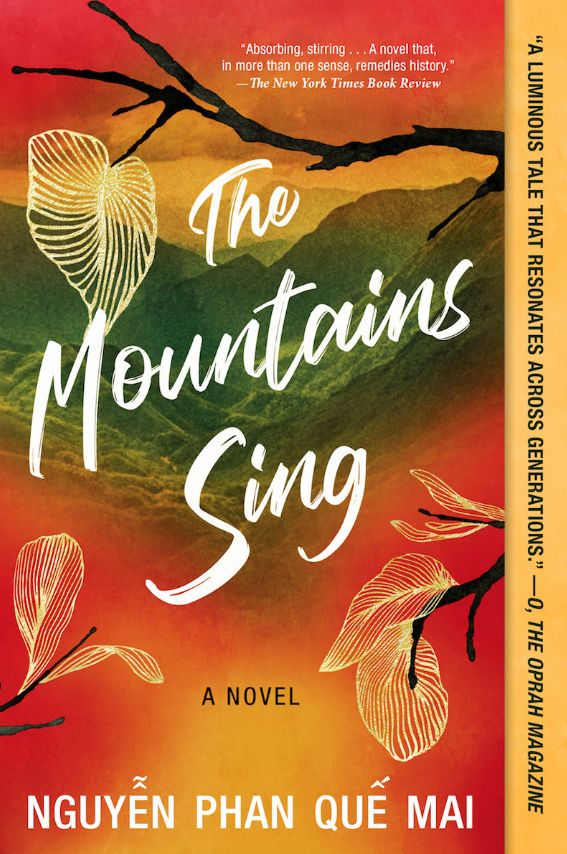
Trần Diệu Lan was born in 1920 and she was forced to flee her family farm with her six children when the Communists came to power in the north and instituted their program of so-called "land reform." At mid-century in Hà Nội, her children head off down the Hồ Chí Minh Trail to fight first the French and then the Americans for control of their country. It was a conflict that tore her country and her family apart.
This is the first account I have read of that conflict from the point of view of the Vietnamese. It was really the defining conflict for my generation and it behooves us even now to try to understand what happened and how our country was drawn into it.
The multigenerational tale is told mostly from the point of view of women - grandmothers, mothers, and their children. The writer says that some of it is based on stories from her own family but that interviews with others who experienced these events as well as much reading of Vietnamese history also went into the writing of the book.
It is a brutal history with hardship, hunger, and death as constant companions in the lives of ordinary Vietnamese. Reading it gave me some understanding of the toughness of these people and their overwhelming sense of pride in their history and their customs and beliefs.
The Mountains Sing depicts an intimate family story spanning generations from the 1920s to the 1070s. I felt very connected to the narratives of the grandmother and granddaughter as they experienced the Great Hunger, Land Reform, and finally the War. Through them, we see the impact that all of these events had on ordinary people. At one point, the granddaughter says, “As the war continued, it was Grandma’s stories that kept me going and my hopes alive.”
The grandmother explained why she told the stories: “Do you understand why I’ve decided to tell you about our family? If our stories survive, we will not die, even when our bodies are no longer here on earth.”
This book sounds fascinating! I work with someone who had to flee Vietnam as a child, and some of the stories he tells about what happened to his family at that time is pretty heart-breaking. I keep telling him he should write them down.
ReplyDeleteIt is a fascinating book and I hope it finds a wide audience.
DeleteI would be very interested to read this story. I'd love to hear more about the stories from Vietnam as experienced by the people who lived there.
ReplyDeleteI found it to be a well-written and very interesting tale which gave me a much better understanding of the background to the war that was so much a part of my young adulthood.
DeleteI have lasting memories of my visit to Vietnam, the fact that the war was called the American War, which of course is what it was, and talking to people about their experiences. One fellow we used as a guide in Cat Tien National Park for three days was a former officer in the Liberation Army. Signs of the war were everywhere - mixed race children, birth defects from exposure to Agent Orange and a landscape still scarred and stunted in places. And for what? At the end of it all there was nothing bu ignominious defeat.
ReplyDeleteIronically, this country has been greatly enriched by Vietnamese immigrants. Over the years, I worked with several of them and got to know a little of their rich culture and history. One of my younger daughter's best friends is a daughter of Vietnamese immigrants. It is strange how the circle of life goes round.
DeleteI'm glad you read & reviewed this one. It had previously been on my TBR list but then I didn't get to it. Would you say her writing style the background info is easy to understand? thanks. I will put it back on my list.
ReplyDeleteI would say it is very easy to understand. The book is very well written and I hope to see more from this author.
Delete