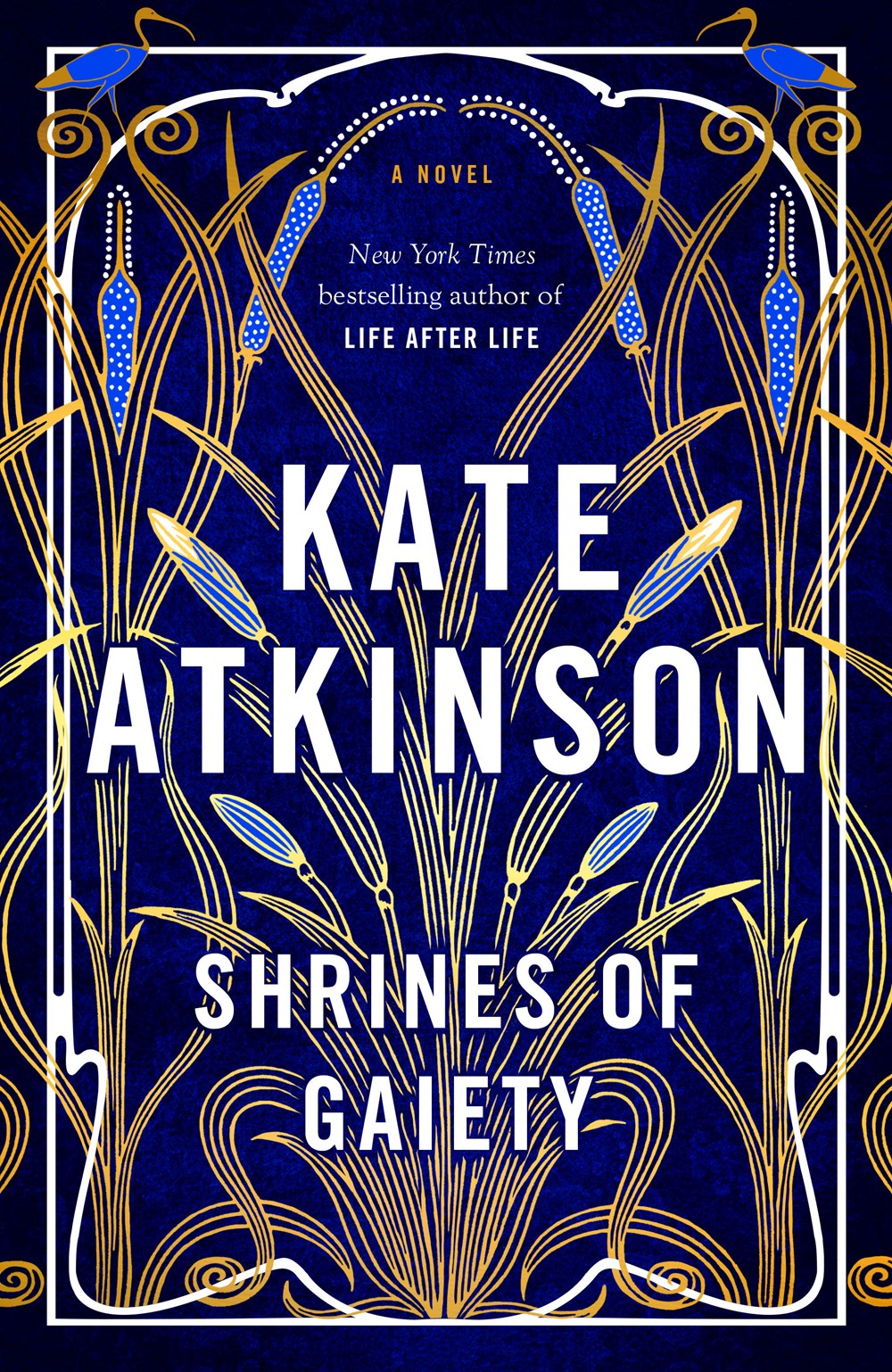
Shrines of Gaiety by Kate Atkinson: A review


In her latest book, Kate Atkinson gives us 1920s London. It was a fraught time and place with a multilayered society full of drugs, the sex trade, mob wars, and the posh clubs that were the center of it all. Overseeing all that was Nellie Coker, Ma Coker.

Nellie was the shrewd owner of a string of nightclubs. When we first meet her, she has just been released from a stay in prison. Even so, though she exists in a dangerous world and has enemies all around, she is the queen of all she surveys. 

Nellie was indeed Ma to six duplicitous children who, in addition to all of her business interests, kept her on her toes. We see many of the events through the eyes of the eldest child, Niven.  He is a rather enigmatic character, home from his recent service in World War I. His character was essentially forged by his experiences in that war, especially his time in the Somme.

In addition to Nellie and Niven, there are a multitude of other characters, almost too many to keep track of, but Atkinson is a pro and she gives each of them a unique voice which helps the reader to make connections and keep them all straight. 

Although it is eight years after the end of the Great War, England is still recovering and the frenetic nightlife of Nellie's clubs helps the patrons to forget, at least for a little while. There are hostile forces all around, many of whom would take Nellie's empire from her if they could, so in order to protect the empire and continue to provide for her children, with no husband there to help her, she must be on constant alert.  

There is so much here, it is really difficult to summarize it all in a brief review. Atkinson has obviously done much research on this period and she paints a vivid and memorable picture of post-war London. It is a compelling storyline that completely absorbed me from beginning to end. In fact, my initial rating on the book was four stars, but on reflection, I really can't think of any good reason to take away a star. Five stars it is!   

Comments

  1. I do love that 1920s setting, though I usually associate it with New York, not London, for some reason. :D

    ReplyDelete
    Replies
    1. It must have been a very interesting time in both cities.

      Delete
  2. Five stars! I will forward this title to Miriam.

    ReplyDelete
  3. I've had my eye on this one because Atkinson has never disappointed me, so it's good to see it get five stars from you.

    ReplyDelete
    Replies
    1. She's never disappointed me either and this one was right up to her high standards. I've noticed that it is appearing on lots of "best of 2022" lists that have been coming out this week. It'll be on mine as well.

      Delete
  4. Excellent Dorothy. Glad that this novel delivered. I think post-WWII London-set books are usually quite fascinating so I am curious about this one and would like to read it.

    ReplyDelete
    Replies
    1. I suppose any post-war setting has a built-in drama to it and the post WWI depicted in this book certainly did.

      Delete

Post a Comment

Popular posts from this blog

Poetry Sunday: Don't Hesitate by Mary Oliver

How about we share another Mary Oliver poem? After all, you can never have too many of those. In this one, the poet seems to acknowledge that it is often hard to simply live in and enjoy the moment, perhaps because we are afraid it can't last. She urges us to give in to that moment and fully experience the joy. Although "much can never be redeemed, still, life has some possibility left." Don't Hesitate by Mary Oliver If you suddenly and unexpectedly feel joy, don’t hesitate. Give in to it. There are plenty of lives and whole towns destroyed or about to be. We are not wise, and not very often kind. And much can never be redeemed. Still, life has some possibility left. Perhaps this is its way of fighting back, that sometimes something happens better than all the riches or power in the world. It could be anything, but very likely you notice it in the instant when love begins. Anyway, that’s often the case. Anyway, whatever it is, don’t be afraid of its plenty. Joy is no...

Poetry Sunday: Blackberry-Picking by Seamus Heaney

My mother was a farm wife and a prodigious canner. She canned fruit and vegetables from the garden, even occasionally meat. But the best thing that she canned, in my opinion, was blackberry jam. Even as I type those words my mouth waters!  Of course, before she could make that jam, somebody had to pick the blackberries. And that somebody was quite often named Dorothy. I think Seamus Heaney might have spent some time among the briars plucking those delicious black fruits as well, so he would have known that "Once off the bush the fruit fermented, the sweet flesh would turn sour." They don't keep; you have to get that jam made in a hurry! Blackberry-Picking by Seamus Heaney Late August, given heavy rain and sun For a full week, the blackberries would ripen. At first, just one, a glossy purple clot Among others, red, green, hard as a knot. You ate that first one and its flesh was sweet Like thickened wine: summer's blood was in it Leaving stains upon the tongue and lust ...

Poetry Sunday: Hymn for the Hurting by Amanda Gorman

You probably remember poet Amanda Gorman from her appearance at the inauguration of President Biden. She read her poem "The Hill We Climb" on that occasion. After the senseless slaughter in Uvalde this week, she was inspired to write another poem which was published in The New York Times. It seemed perfect for the occasion and so I stole it in order to feature it here, just in case you didn't get a chance to read it in the Times . Hymn for the Hurting by Amanda Gorman Everything hurts, Our hearts shadowed and strange, Minds made muddied and mute. We carry tragedy, terrifying and true. And yet none of it is new; We knew it as home, As horror, As heritage. Even our children Cannot be children, Cannot be. Everything hurts. It’s a hard time to be alive, And even harder to stay that way. We’re burdened to live out these days, While at the same time, blessed to outlive them. This alarm is how we know We must be altered — That we must differ or die, That we must triumph or try. ...