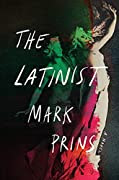
I'm always a sucker for the classics. Anything with a Latin or Greek connection appeals to me, so obviously, I'm going to grab a book called The Latinist. It was a good move. It proved to be quite an entertaining read. The book turned out to be a suspense novel involving classicists. Clever, huh?
Tessa Templeton is a Ph.D. candidate in classics at Oxford. She is ready to seek a job in the world of academe and her mentor, Professor Christopher Eccles, has written a letter of recommendation for her. Except that, as Tessa learns thanks to an anonymous informer, the letter doesn't exactly recommend her. It's a classic case of damning with faint praise. Very soon we learn that Eccles' motive in writing such a letter is to keep Tessa at Oxford. He wants her only chance for employment in her field to be at that university because it is where he is and he is obsessed with her.
Tessa is a rising star in the arcane world of classics. She has just had a paper accepted for publication and her monograph is under consideration for publication by Oxford University Press. So, it is very odd that none of her applications for employment have resulted in job interviews while many lesser qualified candidates are being given interviews every day. When she sees a copy of the letter that Eccles wrote, she at first thinks it was a practical joke but then she comes to understand that he has effectively sabotaged her. How will she overcome his attempt to keep her close to him and under his control? She has to outthink him.
We quickly come to understand that these two characters are actually mirrors of each other. Each of them is monomaniacally dedicated to research in their field to the extent that, in Tessa's case, she chooses to miss her boyfriend's father's funeral in order to attend an academic conference. He doesn't stay her boyfriend for very long but she has demonstrated that she has the lack of moderation to be a serious player in the fight to get tenure.
Tessa's expertise is in the field of obscure Roman poets but she is also a scholar of some renown on the Daphne and Apollo myth, the one where Daphne escapes ravishing by Apollo by transforming herself into a laurel tree. The Latinist is, in fact, a modern retelling of that story with Tessa as Daphne and Eccles as Apollo. Tessa's plan to escape Eccles' grasp leads her to join an archaeological dig at Isola Sacra near Rome. It proves an excellent decision when she makes a spectacular find in a necropolis that just may allow her to escape from under her mentor's thumb.
Prins' retelling of Daphne and Apollo is quite an evocative and mesmerizing bit of writing. It held my attention throughout and I found it hard to put down. I guess my only complaint about the book would be that both of the main characters are just about equally unlikable. Not that a book must have likable characters but it does help to invest the reader in the story. The ending of this one is startling and reminded me a bit of Alfred Hitchcock. He, too, often managed to give his tales a surprising twist.
My rating: 4 of 5 stars
Ooh...I love the sound of this one.
ReplyDeleteIt was quite an entertaining read. I think you might like it.
DeleteI never heard of this one but, I like the sound of it even if the characters are unlikable --sometimes if the story is interesting enough, it just doesn't matter. (BTW: If I don't visit as often, in the next several months, it is because life has thrown me a curveball.)
ReplyDeleteI quite understand. My condolences on your loss. I'll be here whenever you are ready to visit.
DeleteOh, I hate that the characters are unlikable. The rest of the plot sounds fascinating, and I never got beyond Julius Caesar in my Latin classes. Competition in academia can be as obsessive as in sports. I like the sound of this one: classics, myth, and an archaeological dig!
ReplyDeleteYou've mentioned the exact factors that led me to read it. I was not disappointed.
DeleteReminded you a bit of Alfred Hitchcock. I feel like that's a plus! But I'm not the biggest fan of unlikable characters.
ReplyDeleteAnything that reminds one of Hitchcock is a definite plus.
Delete