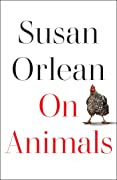
For example, there is the one about Keiko, the captive killer whale who starred in the movie "Free Willy." The essay is about efforts to free Keiko and it begins like this: "It was a hell of a time to be in Iceland, where the wind never huffs or puffs but simply blows your house down." How can you not be captivated by such a beginning?
This book isn't only about big and famous animals, however. There are chickens here, and rabbits, pigeons, pandas, tigers, lions, donkeys, mules, and oxen. And that's probably not a complete list.
One of my personal favorites was the essay about keeping backyard chickens. I was especially delighted to learn that this famous writer for an urban publication did this for I am not unfamiliar with the pleasure of having chickens around. Those who think of them as stupid, ditzy creatures have never spent much time with them. They each have their own unique personalities and they arrange themselves in definitive social structures. The chicken yard is not all that dissimilar to human society.
Another of the essays deals with a backyard in New Jersey where a woman kept twenty-three - twenty-three! - pet tigers. The remarkable thing (in addition to all those tigers) is that her neighbors had no idea they were there until one of them escaped.
There is not a dull essay in this collection. I read straight through rather than skipping around because the clever arrangement of the pieces helped to lead the reader from each essay into the next one.
Orlean has a knack for pulling the reader in with her first sentence. It's a knack honed over all those years of writing for The New Yorker. She also has a gift for exploring the human connection to all of the animals about which she writes. She makes clear that it is false to think of these as human-animal relationships; in fact, we are all animals and we are all in this together. One planet for all of us and what we do to that planet affects all.
My rating: 4 of 5 stars
I am quite sure I would enjoy this book and I will seek it out. As for chickens, I have spent countless hours watching them, right from my earliest memories, and I have a deep and abiding love and respect for them. Stupid, dirty creatures seems more like some of the humans I have seen on television recently, and they cackle more too.
ReplyDeleteI can't disagree, David.
DeleteThanks for visiting and taking time to comment.
ReplyDeleteGlad you enjoyed this. I liked the essays but, did not like that the author narrated her audio version - it grated on my at times.
ReplyDeleteI had the print version so no problem with the narration. I am very sensitive to voices though and if I had found it unpleasant it would have been hard for me to focus on the information being shared.
DeleteI love that first sentence you quoted. It's another one of those that I wish I had thought of myself...seems so simple when you see someone come up with something clever as that, but it never is. I have a friend who fell in love with chickens when she decided to provide herself with fresh eggs. She still uses the eggs, but her ever-growing number of chickens has provided her with more "pets" than she ever dreamed she would have.
ReplyDeleteGrowing up on the farm, one of my jobs was taking care of the chickens, making sure they were fed and had clean water and occasionally cleaning out their house. As a result of that early experience, I've had a lifelong affinity for them.
DeleteSusan Orlean is a delightful writer who doesn't seem to write fast enough for me. I liked this collection of essays centering on animals, but I hope she is working on a big project, too.
ReplyDeleteShe seems to be quite busy as a writer so I suspect she is on to that "big project."
DeleteI have a fondness for essays and this collection sounds delightful! A favorite essay collection about animals from years ago was Diane Ackerman's The Moon by Whale Light, the essay on bats was my favorite. :)
ReplyDeleteBats are always interesting. I'll have to check out Ackerman's book.
Delete