A roundup of the week's news of birds and the environment:

*~*~*~*
Of course, the main news of Nature for us on this continent this week was all related to wildfires.
*~*~*~*
Wildfires in British Columbia were forcing evacuations.
*~*~*~*
The island of Maui in Hawaii was one of the latest places to suffer the destructive forces of wildfires.
*~*~*~*
It became clear that nonnative plants had fueled the Hawaiian wildfires.
*~*~*~*
In the historic town of Lahaina, a 150-year-old banyan tree was charred but still standing after the fires and has apparently survived them.
*~*~*~*
The staff of the Maui Bird Conservation Center fought the flames to save the endangered birds housed there.
*~*~*~*
Back in the Canadian city of Yellowknife, residents were given until noon on Friday to leave town ahead of the advancing flames.
*~*~*~*
And if it wasn't the heat from wildfires, it was the heat from that orange orb in the sky that was causing misery in many places, not least of which was Texas.
*~*~*~*
A United Nations climate expert warned this week that the world's food supply is threatened by global heating.
*~*~*~*
*~*~*~*
Off the Alaska coast, explorers are studying some of the world's deepest and most remote waters.
*~*~*~*
In California, a new pack of gray wolves has been discovered in Tulare County.
*~*~*~*
And in northern California, the Winnemem Wintu Tribe is working to return Chinook salmon to their ancestral waters.
*~*~*~*
Is it possible for the world to kick its coal habit? There is hope.
*~*~*~*
Paradoxically, it seems that the way to save the redwood forest may involve the judicious use of chain saws.
*~*~*~*
The farming of kelp is yet another enterprise that is threatened by the heating up of the world's oceans.
*~*~*~*
Trout introduced into Wyoming lakes have shown an ability to evolve rapidly in order to take advantage of their new habitat.
*~*~*~*
Proof that perhaps the human race is not entirely hopeless: This man uses an ultralight aircraft to teach endangered Ibises their migration route.
*~*~*~*
Great white sharks are normally solitary creatures, but two that were fitted with tracking devices off the coast of Georgia last December have confounded their trackers by continuing to travel together.
*~*~*~*
And more hope for the future: Some young Montanans have just held their government accountable for exacerbating the climate crisis and violating their fundamental constitutional rights. More of this, please!
Good morning, Dorothy. Yellowknife is the capital city of the Northwest Territories and the entire city has been evacuated. Other areas around Great Slave Lake have also been evacuated and there are countless small communities that have been destroyed. And hundreds upon hundreds of fires are burning all across the country. Whoever could have imagined it could come to this? With a shift in the wind it is possible that Yellowknife could be burned to the ground. Ask people in Maui or Lytton, BC how that feels. Yet people still deny climate change? And I really love those caring pastors who have been preaching god’s eternal and abiding love by saying that it is his retribution for our acceptance of gays, lesbians and other members of the LBGTQ community. Ah, if only we knew……in despair - David
ReplyDeleteIgnorance is a very combustible fuel.
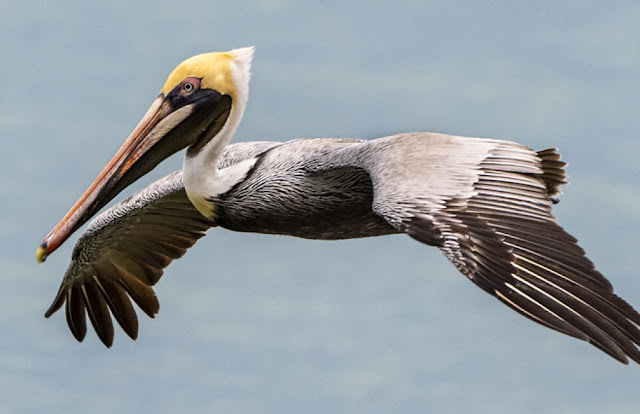
DeleteThe Brown Pelican is one of my favorites, too. They always seem to fly in small groups, and they do look prehistoric.
ReplyDeleteI was delighted to hear about the young Montanans fighting for their rights. Jane Goodall looks to young people for hope.
Jane has always been a symbol of hope for me. I would think that she sometimes gets discouraged by our lack of care for our precious planet. I'm glad she finds hope in the younger generation.
DeleteThe wildfires this year have been so devastating. Especially the one in Maui. It breaks my heart to see the devastation there. Lahaina was such a lovely town; I loved visiting there. I can't believe it's all gone.
ReplyDeleteIt is indeed heartbreaking, even for one who has never been there.
DeleteAnother bumper crop of links to explore, Dorothy. I see that we're both enjoying the cloudless sulphurs moving through.
ReplyDeleteThey are lovely little butterflies that bring joy to my heart!
DeleteBeautiful photo of the Brown Pelican. And love the new wolf pack. Cute pups.
ReplyDelete