A roundup of the week's news of birds and the environment:
I photographed this
Cactus Wren on a trip to West Texas a couple of years ago.
*~*~*~*
This is not really a surprise: Climate change is making summers hotter and drier, exacerbating the drought that is affecting wide areas at the moment.
*~*~*~*
In the southwestern United States, the long-lasting megadrought may bring an end to the farming/ranching way of life that has long been so much a part of the culture of the area.
*~*~*~*
But in another part of the world, the problem isn't drought but monsoon; climate change is increasing the rainfall and making the phenomenon less predictable.
*~*~*~*
In this country, the conservative-packed Supreme Court seems bent on destroying the meager protections for the environment that have been in place. They appear likely to take their scissors to the Clean Water Act, one of the basic protections holding back the developers. What will be left after their hacking away at it?
*~*~*~*
The
American Bird Conservancy's Bird of the Week is the little
Yellow-bellied Sapsucker. It nests throughout the northern regions of the continent and winters throughout much of the southern half.
*~*~*~*
*~*~*~*
We never get glorious fall foliage like this here in the hot and humid South but up north this is the time of year when the
colors are at their best and the "leaf peepers" are out to see them.
*~*~*~*
The fall migration of songbirds is in progress now and cities across the continent as well as individuals are being encouraged to
turn off or at least dim night lights so that they do not confuse the migrants and lead them astray.
*~*~*~*
One good reason to do everything in our power to protect the birds is the fact that, according to the State of the World's Birds report,
nearly half of the world's species of birds are in decline.
*~*~*~*
Some are being proactive about trying to stop the decline of species -
Australia, for example. They have a plan to save 110 threatened species.
*~*~*~*
We know that smoking can be the cause of lung cancer, but there is evidence that even
non-smokers are at risk when they are exposed to air pollution.
*~*~*~*
Scientists have identified a
precursor of the pterosaur, the flying dinosaur, that lived in the late Triassic Period, about 237 million years ago.
*~*~*~*
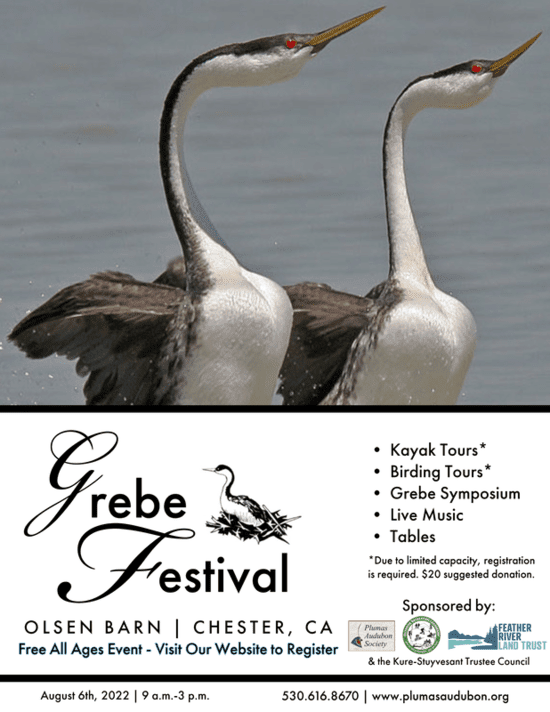
It's already taken place this year but I just had to show you this flyer from the Grebe Festival in Chester, California. I love the eyes on these Western Grebes!
*~*~*~*
Many countries have taken the pledge to try to reduce methane emissions, but in some cases, they are replacing coal with natural gas which will
make meeting their goals impossible.
*~*~*~*
This little fish is a snail darter. A few years ago, it looked like the snail darter might be well on its way to extinction, but thanks to the Endangered Species Act and the Clean Water Act, the little fish was pulled back from the brink. It is no longer facing extinction and has been
removed from the endangered species list.



Good morning, Dorothy: Thank you for the weekly roundup, this great service you render to all of us. I don't claim to understand all the mechanisms of your system of government in the United States, but it seems incredible that the Supreme Court (a handful of justices) can exercise such sway over the nation, even in matters of environmental sanity. And while an elected official can be replaced, a justice of the Supreme Court my be there literally until the day he or she dies. Unbelievable. A Clean Water Act would seem like motherhood to me. Enjoy your weekend. David
ReplyDeleteWhat is more essential to life than clean water and clean air?
DeleteMore and more I feel America is moving from a country with opportunities even for the worst-off among us (a free and good education available; inexpensive housing available; affordable college funding available; jobs available) to a country of the (small) haves and (much larger) have-nots. Our political system is not offering much support for those have-nots, and our environment is also being sacrificed. It's very frustrating for me to see this.
ReplyDeleteI share your frustration. The problem is so big that one feels helpless to affect it and solve it. The least - and it is little enough - that I can do is to document it here and hope that it might encourage others to take whatever action is within their power.
DeleteAnd I am happy you are documenting it here and that you are encouraging others to take any positive action within their power.
DeleteI fear we really are past the point of no return. The high oday was 80, as will be tomorrow. We are in the midwest. It should not be in the 80s here in October. Ugh.
ReplyDeleteOur highs now are in the mid-80s most days but that is pretty standard for us at this time of year.
DeleteI had to smile at this week's photo. When Denis and I were at the Desert Botanical Garden recently, the cactus wrens were out in force and being very visible and vocal.
ReplyDeleteCactus Wrens, like most wrens, are real characters!
DeleteWow interesting photo of the Grebes ... I have not seen those birds before. Red eyes?
ReplyDeleteThey do have red eyes, their most arresting feature, IMHO.
Delete