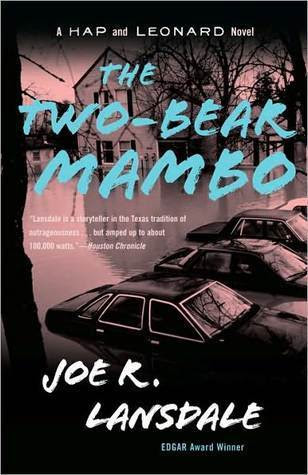
 There are twenty-six books in Joe K. Lansdale's Hap and Leonard series dating all the way back to 1990. Two-Bear Mambo is the third book in the series, published in 1995. I've not read any of the others and just decided on a whim to read this one. The series is set in the fictional town of LaBorde in East Texas, an area I'm somewhat familiar with.
Hap and Leonard are described as amateur investigators and adventurers. Hap Collins is a White working-class laborer who spent time in federal prison back in the day when he refused to be drafted into the military during the Vietnam War. He believes in non-violence and does his best to avoid conflict. Leonard Pine is a gay, Black Vietnam vet with some serious anger issues. He has no tolerance for racist and/or gay slurs. He is quick to anger and doesn't really understand Hap's more passive approach to life. These two opposites are the best of friends.
In this entry, Hap's ex-girlfriend Florida Grange, who is also Leonard's lawyer, had set out to try to recover some long-lost tapes of a deceased blues musician. Unfortunately, the tapes are thought to be in the Klan-infested town of Grovetown in East Texas and the ex-girlfriend has now apparently disappeared there. There is reason to fear for her safety because she is a Black woman who was asking inconvenient questions in a racist town.
She had been investigating the jailhouse death of a legendary bluesman's son who is believed to have been in possession of those missing tapes. He had supposedly committed suicide while in jail but there may be reason to question the official explanation.
As Hap and Leonard set out to try to find Florida, they also must face a threat from the weather. An East Texas monsoon is brewing with its attendant flooding and they must race to try to find Florida before the storm adds another layer of difficulty to an already difficult task.
The relationship between Hap and Leonard is an interesting and complex one and Lansdale describes it believably. Moreover, his descriptions of the East Texas landscape and zeitgeist rang true for me. As one who traveled those roads for many years as a state employee, I could clearly recognize both the people and countryside which they inhabit. In reading about the author, I was interested to see that he himself lives in Nacogdoches in the same county where I lived for many years, so I think he came by his knowledge of the area quite honestly.
Hap and Leonard sound like quite the interesting duo. Do you think you'll read more books in this series?
ReplyDeleteI probably will read more of the series at some point but they have to get in a (very long) line!
DeleteI really enjoy reading a book that's set in an area I know well and the author gets it right. On the other hand, if an author gets it wrong, I have a tendency not to read any more of that person's books. Harsh, I know. I had a favorite non-fiction writer. I loved that man's books, but when I came across a glaring error about the Mississippi River (and it wasn't an obscure fact), I was so gobsmacked that no one had caught it that I wondered how many other errors had slipped through the cracks, and I haven't read any of his new books.
ReplyDeleteI agree. If it's a place you are familiar with and the writer makes a glaring error, it is hard to overlook it. I say that as someone who grew up in Mississippi reading Faulkner. He's pretty much my gold standard for "getting it right."
DeleteThe idea of Hap and Leonard as best friends sounds wonderfully appealing to me. I know that part of the country well, and I'm glad the author was able to accurately depict this place.
ReplyDeleteLiving there helps with that, I'm sure!
DeleteI am always looking for new authors to read. I'll add this one to my list! Thanks!
ReplyDeleteI hope you enjoy his work.
DeleteI am sure it adds an extra level of interest when you are familiar with the area, both geographically and from the standpoint of its customs and social values.
ReplyDeleteIndeed.
Delete