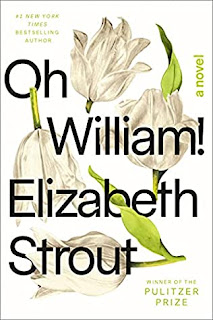
The William of the title is Lucy's first husband with whom she had two daughters. William was serially unfaithful in the marriage and finally, Lucy took her two daughters and left him. This was especially traumatic for the daughters who loved their father, but they survived, and eventually, Lucy married again to a man who was just what they needed. He provided stability and love and he and Lucy had a very happy marriage. Sadly, he had recently died at the time that this story begins.
Meanwhile, William also remarried a couple of times and he and his third wife had a daughter. Then his history repeated itself. His wife took their daughter and left him.
One of Lucy and William's daughters had given her father a membership in one of the DNA matching organizations that identify one's relatives and ancestors. Through it, he had learned that he had a half-sister that he never knew about. She lived in Maine. At loose ends after his wife and daughter left, he decided to go to Maine to meet his sister. But he didn't want to go alone. He and Lucy had always maintained an amicable relationship and he asked her to go with him. Most of the narrative details their trip.
Loneliness and grief are the overriding themes of that narrative and it is richly mesmerizing. Lucy is the narrator of the story. She is now a very famous writer and she says the only way she can tell the story is as a novel/memoir. She tells us a lot about her life with William and weaves it into her history with her second husband. We learn that her current relationship with William is deep and complicated, based upon their history together and the two daughters they share. Her portraits of those daughters, too, are vibrantly drawn. We hear less about William's third wife, Estelle, and their daughter but all of these people, including Lucy's recently dead husband, serve as a palpable background for the ebbs and flows of the Lucy/William relationship at center stage.
The intimacy and fragility of close human relationships are the continuing themes of the narrative and it makes for breathtaking reading. But even in the most intimate relationships the possibility of being completely open and honest is problematic. As Lucy says near the end of the book, "People are lonely, is my point here. Many people can't say to those they know well what it is they feel they might want to say." In this book, though, the amazing Elizabeth Strout accomplishes that.
My rating: 5 of 5 stars
So happy to read how much you loved this (me too!) Strout is an amazing writer. I did something, I never do after reading Olive Kitteridge and Olive, Again - I purchased these for a future reread.
ReplyDeleteShe has had a remarkable string of excellent books including the ones featuring Olive. I've read them all and loved every one. If I reread them I'd probably love them even more!
DeleteI agree with you...as much as I liked the earlier Lucy Barton books, I think this is my favorite of the bunch. Strout is an amazing writer, one of my favorites.
ReplyDeleteWe are unanimous in that!
DeleteI started this on my Kindle and got waylaid, but hope to get back to it soon. Sounds very worthwhile.
ReplyDeleteI certainly thought so.
DeleteThank you for a great review. I am putting this book on my TBR.
ReplyDeleteYou won't be sorry!
DeleteOh, William was my first by Strout, and I really liked it. I'm glad that, as the third in the series, it wasn't a disappointment for you. Sometimes the second or third book doesn't live up to previous books. I loved the writing.
ReplyDeleteI particularly enjoy her style of writing. All those awards and acclaim she has received are well earned.
DeleteI loved Olive Kitteridge & I'm really not sure why I haven't read anything else of hers yet.
ReplyDeleteIf you loved Olive, you're going to love Lucy as well.
Delete"It did not disappoint. In fact, it may be my favorite of the three." High praise. My copy is waiting for me at the library. I'm not sure I can wait until Nonfiction November is over until I read it.
ReplyDeleteDon't wait! It's great.
DeleteI still need to read Olive Kitteridge! I'm so far behind on my TBR list it's sad. ;D
ReplyDeleteIt's a common malady of constant readers.
DeleteI'm glad to hear that you think this is the best of the Lucy Barton books. Excellent news. I was a big fan of both the Olive books ... and read Book 1 of Lucy. I agree she's a very perceptive writer!
ReplyDeleteI've liked them all but I just really loved this one.
DeleteSounds like a wonderful book. I'm not sure I've read anything by Elizabeth Strout before.
ReplyDeleteShe's a terrific writer. Highly recommended.
Delete