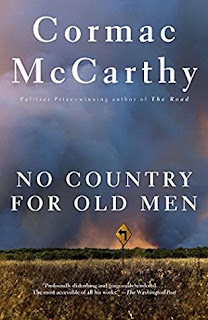
You've probably read the book or seen the popular 2007 Coen brothers movie based on the book. There was, of course, a lot of talk about the movie after it came out and especially after it won the Oscar for Best Movie, so even though I hadn't read the book or seen the movie, I was already fairly familiar with the plot. My memory of the plot may have been a bit faulty though, or maybe the emphasis of the movie was different from the book. Mostly what I had remembered was the killer Anton Chigurh and the trail of bodies he leaves behind. The book, however, featured a narrative by Sheriff Ed Tom Bell which gave a lot of exposition and moved the plot along.
The other central character was Llewelyn Moss who initially sets the plot in motion. While out hunting pronghorns, Moss stumbles on the aftermath of a drug deal that went awry, somewhere along the Mexican/American border in remote Terrell County, Texas. Moss finds everyone dead except for one badly wounded Mexican who pleads with him for water, but Moss has none to give. When he searches the vehicles, he finds a truck full of heroin. Some distance away from the other bodies, he finds a dead man with a satchel that contains $2.4 million in cash. He takes the money and goes home, but then he returns to the scene with a jug of water for the wounded man. He finds that the man has been shot and killed in the interim. He is seen by the apparent killers and they chase him across a desert valley. He manages to escape but for most of the rest of the novel, the killers are chasing him.
Returning home, Moss sends his wife, Carla Jean, to her grandmother in Odessa, hoping to keep her safe, while he takes the money and runs.
Sheriff Bell investigates the drug deal gone bad and the resultant deaths. Learning of Llewelyn's involvement, he attempts to protect him and his wife. They are residents of his county and he feels responsible for them. But his attempt to keep them safe is complicated by the arrival of ruthless hitman Anton Chigurh on the scene. He has been hired to find and return the money. He will go to any lengths to accomplish the task he has been hired for and will kill anyone who stands in his way. The reader intuits pretty quickly that this will not end well for Llewelyn Moss.
This book was published in 2005. The story was originally written as a screenplay. I looked at some of the reviews of the novel that appeared at the time of its publication and saw that some of the professional critics who did not like it, and there were a few, complained about the book being "too cinematic." Huh? Is that really a bad thing? Not being a professional critic, maybe I'm just not sophisticated enough to see the problem with that. I loved McCarthy's vivid exploration of the darker side of human nature, not only in Anton Chigurh but in Sheriff Bell as well. Bell is haunted by his actions in World War II. (This book takes place in 1980 when he is in his 50s.) He received a Bronze Star for action in which he feels that he failed his unit and left them to die. He has spent the rest of his life trying to make up for that failure. I particularly enjoyed Bell's narrative in the book and felt that it was both the glue that held the plot together and the engine that moved it along.
Llewelyn's actions, too, have their dark side. He could have turned the money in. He didn't have to run with it and focus the attention of a professional killer on himself and his wife, putting her as well as himself in mortal danger. And, of course, Chigurh is darkness itself. He is essentially a psychopathic killer who takes a lot of pleasure in his work.
McCarthy is an extremely gifted writer and I enjoyed this book quite a lot. Several of the critics that I read said that it is inferior to his other work. Now I need to read some of that other work and make my own judgment.
My rating: 5 of 5 stars
Great review, Dorothy.
ReplyDeleteI really liked Sheriff Bell and his struggles to understand the changes in society. I also liked All the Pretty Horses and The Road.
ReplyDeleteYes, Bell was really a sympathetic character, haunted by his past and trying hard to live a good life in a complicated world. I liked him a lot, too. And I want to read both of those books you mention. Maybe in 2022.
DeleteGreat review. Going to check it out.
ReplyDeleteIt's a very well-written book with an engrossing story. I think you might like it.
DeleteI'm a McCarthy fan of sorts and have enjoyed most of his books. My favorite of his, I think, is "All the Pretty Horses," one of the saddest coming-of-age novels I've ever read. I liked "No Country for all Men," but I found that one and "The Road" to be my least favorite of his books. He comes across a lot differently in the novels he sets around the turn of the twentieth century...more serious, somehow.
ReplyDeleteThen you are in agreement with some of the critics I read. I'm now looking forward to reading those other books.
DeleteThe only book I've read of his is "The Road" and I loved it but parts were pretty disturbing. I love the movie "No Country For Old Men".
ReplyDeleteI think it was actually The Road that those who warned me against him had in mind, but I do hope to read that at some point in the coming year.
DeleteI've only read "The Road" and it was a Did Not Finish for me. Not because it was badly written, not at all. It was so dark and emotionally overwhelming that I could not bear it. Not sure I would attempt No Country For Old Men (and, incidentally, I have never seen the movie).
ReplyDeleteI count myself fairly sensitive, but I honestly did not find the violence in this book any more upsetting than any typical thriller or literary fiction that deals with violent issues.
DeleteThank you for a great review.
ReplyDeleteAnd thank you for stopping by, Mystica.
DeleteI have not read anything written by Cormac McCarthy and need to remedy that!! I did see the movie version of No Country for Old Men. Javier Bardem played Anton Chigurh in the movie version... I've never seen a more credible, psychotic bad guy ever in my life!! Believe me when I say that Bardem deserved the Academy Award for his role as Anton Chigurh.
ReplyDeleteI remembered that Bardem got a lot of praise and honors for his role in that film. He's always been believable in every role I've ever seen him in.
DeleteLol, I just remembered that I've read The Road by Cormac McCarthy!! I'd forgotten that The Road was written by Cormac McCarthy... I read it before I began blogging. so never reviewed it.
DeleteWhen one is a constant reader, it is easy enough to sometimes forget titles we've read. I've done that, too.
DeleteI read this book in 2009 after receiving similar warnings from others. I found it violent, but not gratuitously so. I also rated it five stars.
ReplyDeleteThe only other McCarthy book I've read is The Road. It was also violent, I thought, but again the violence was justified. It was another five star read.
The Road is definitely going on my list for next year!
DeleteI've heard good things about McCarthy's writing, but the plots of his books have never really interested me. But I'm glad you enjoyed this one so much.
ReplyDeleteIt was a departure from my usual reading, but yes, I did enjoy it.
Delete