~~~
Monday, June 23, 2014
One Hundred Years of Solitude by Gabriel Garcia Marquez: A review
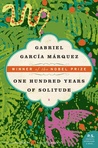 One Hundred Years of Solitude by Gabriel García Márquez
My rating: 5 of 5 stars
It's a good thing the writer and/or publisher decided to place a Buendia family tree chart at the beginning of this novel. Otherwise, it would have been impossible to keep track of all the Jose Arcadios, Aurelianos, Amarantas, Ursulas, and Remedios that keep recurring throughout the multiple generations of the family that we meet in One Hundred Years of Solitude. Even referring to the chart with each new chapter, it was not easy to keep them all straight.
But then there is nothing easy about this book. I first read it many years ago - in the '70s or 80s, I think - but when Gabriel Garcia Marquez died in April and I was thinking about the books of his that I had read, I found that I really couldn't remember much about this one except that famous opening sentence and the broadest of outlines of the story. So, I determined to read it again...and found it just as difficult as the first time around.
Difficult, yes, but it is an amazing work of literature. What an imagination the man had!
Marquez tells the story of the mythical town of Macondo through the history of the Buendia family. The patriarch Jose Arcadio Buendia and his wife Ursula Iguaran travel from the coastal town of Riohacha, through an interminable swamp, to find the spot where they will found their family and their town. One son, Jose Arcadio, is born on the trip. Another, Aureliano, was the first person to be born in Macondo. Still later, a daughter, Amaranta, is born.
Jose Arcadio inherited his father's headstrong, impulsive nature. He eventually left the family to chase his dream but returned years later claiming to have sailed the seas of the world. He later marries his adopted sister Rebeca.
Aureliano was thought to be able to predict the future and his premonitions always seemed to come true. He became a revolutionary, a constant warrior against the government. During his wars, he managed to find time to father seventeen sons by different women. All the sons were named Aureliano and all of them were murdered by unknown assassins before they reached the age of thirty-five. The original Aureliano was the colonel about whom that famous first sentence was written:
Many years later, as he faced the firing squad, Colonel Aureliano Buendia was to remember that distant afternoon when his father took him to discover ice.(Spoiler alert: The firing squad doesn't get its man. Aureliano lives to a ripe old age.)
Amaranta, the daughter, grew up as a companion of her adopted sister Rebeca - who was actually a cousin. She learned to hate Rebeca because she became a rival for the affections of one Pietro Crespi during their teenage years. Amaranta never married and, at the end of her long life, she died a virgin.
All three of these characters were loners. Solitude might have been their middle names and that continued to be true of all the Jose Arcadios, Aurelianos, and Amarantas who followed.
Throughout the history of the family, incest is a recurring theme. Ursula lives in fear that a Buendia child will be born with a pig's tail because of this inbreeding. Finally, in the seventh generation, the final Aureliano is born with a pig's tail, but by then Ursula is no longer alive to see it. That Aureliano doesn't last long. As an hours-old infant, he is devoured by red ants before the town of Macondo itself is destroyed by a "biblical hurricane."
The Buendia family history is a human tragicomedy. The story does have its moments of humor spread throughout the tawdriness and the pathos. It has, in fact, all the rich variety of life and death, love and lust, war and peace, and all the other universal themes that are present in the history of humankind.
While deceptively simple in its delivery, One Hundred Years of Solitude blends the everyday with the miraculous. Thus, we have a young woman, hanging out laundry to dry, suddenly and inexplicably ascending into heaven never to be seen again.
Moreover, members of the Buendia family routinely live well into their second century, some reaching the age of 125 or even 145. And the spirits of the dead continue to hang around Macondo. It is a mythical and magical world and yet it is populated by ordinary people with commonplace concerns and passions.
Finishing this book, the reader is overcome by something that must be akin to battle fatigue. It is an overwhelming story full of so much detail that it seems impossible to absorb it all. It is difficult to say that one actually enjoys reading such a book and yet there is no denying that reading it is a stunning experience that leaves the reader with a sense of the profundity as well as the ultimate meaningless of life.
Perhaps, years from now, I will remember the distant afternoon when I finished this book for the second time and will discover that I am able to recall just a little bit more than the general outline of the tale.
I have never even tried Gabriel Garcia Marquez. My time is overdue and I owe it to myself to give it a shot.
ReplyDeleteAs I've tried to convey, reading him can be a hard slog and yet the brilliance of the writing keeps you going. It's ultimately a very rewarding read.
DeleteMy Spanish is not strong enough to read it in the original, and no matter how accomplished the translator, nuances are lost.
DeleteAn excellent point. One always wonders what is "lost in translation".
DeleteAn excellent review capturing all the difficulty and wonder of reading the book. I hope to reread it myself one day.
ReplyDeleteIt is a book that would benefit from several rereadings, I think. There is always more to discover and learn there.
Delete