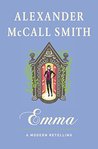
 Emma: A Modern Retelling by Alexander McCall Smith
My rating: 5 of 5 stars
Emma is one of my, and I think most Austen fans', favorites among the Austen oeuvre. That busybody controlling snob, Emma, is one of Jane Austen's most insightful, acerbic, and exasperating characters. She is a privileged little rich girl who believes she knows what is best for everyone around her and constantly schemes to order their lives in the manner that she believes is best for them. One feels the urge to grab her by the shoulders and shake really hard while saying, "Get a grip, Emma! People have a right to live their own lives as they see fit!"
But, of course, if she didn't interfere, we wouldn't have had that wonderful character and that wonderful book.
It takes a very brave writer, I think, to take on the task of rewriting that much-loved book, but that is exactly what Alexander McCall Smith has done. He accepted Emma as his assignment in the Austen Project which gave modern writers the task of updating her books to modern times. I recently read and enjoyed Eligible, Curtis Sittenfeld's updating of Pride and Prejudice, and I was eager to see what could be done with Emma as a modern character. I was not disappointed. I think McCall Smith did a marvelous job of transporting Emma and the other characters to the 21st century.
He begins his modern retelling with the birth of Henry Dashwood during the Cuban missile crisis. The anxiety of his mother during that perilous time was transmitted to the baby and he grew into an anxious man who saw danger everywhere.
Our modern Dashwood marries and has two daughters and then his wife dies, leaving him as a clueless widower trying to cope with two little girls. Fortunately, into their lives comes Miss Taylor, the governess, who became like a second mother to the girls, especially to the younger one, Emma.
The two girls, Isabella and Emma, grow up and Isabella marries photographer John Knightley and moves to London to produce a horde of children. Emma goes to college in Bath, studying interior design, and comes home to set up her own business back in her home town. That is her announced plan, at least. Her unannounced plan is to be a matchmaker and to get all of her friends and acquaintances set up in happy relationships, and she gets to work on it right away.
Her first...er...client/victim(?) is Miss Taylor and she successfully (she thinks) matches her with their neighbor, Mr. Weston. That works out so well that Emma is encouraged to make other matches. She spends the summer manipulating her friends and acquaintances, pushing them in the directions she thinks they should go, whether they want to or not.
Well, the story of Emma is very well known and there is no need to recount it all here. What is important to say is that McCall Smith succeeds admirably in modernizing this 200-year-old story. I think even Jane Austen would approve.
Alexander McCall Smith actually has much in common with Jane Austen, I think, not least of which is his love of language and the deftness and astuteness of his prose, finding exactly the right word to describe a character or a scene or an emotion. He also has a playful quality to his writing that is not unlike the social comedy for which Austen was famous.
In short, I think even Saint Jane might appreciate this book and smile to see her Emma still trying to arrange the world to her liking in the 21st century, and learning, at last, that the world doesn't want to be arranged and that Emma doesn't always know best. The precision of language and sharp, yet gentle, wit that mark the book would not be unfamiliar to Jane, and they are certainly not unfamiliar to fans of Alexander McCall Smith's other work, such as the wonderful The No.1 Ladies Detective Agency series.
Anyone who has enjoyed the original Emma would most likely be entertained by this modern retelling, but even those who haven't read the original should be able to enjoy it for what it is: a well-told fresh and funny story with a highly entertaining plot.
View all my reviews
This project is proving successful reading-wise. I told myself: "Isn't that the author of one of the series Dorothy reads?" And you answered my question. :-)
ReplyDeleteSmith specializes in gentle, philosophical humor in his books. It fit well with Austen's Emma.
DeleteSomehow I missed that there was an entire Austen Project. Cool! I am going to start with Eligible and go from there. I never could get into Emma but there is always another day to try!
ReplyDeleteI think you might enjoy Smith's Emma.
Delete