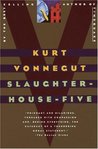
 Slaughterhouse-Five by Kurt Vonnegut
My rating: 4 of 5 stars
Slaughterhouse-Five was Kurt Vonnegut's noble effort in 1969 to make sense of a lunatic universe in which a whole city could be destroyed and 130,000 people killed, not because the city had any military value or the people posed any military threat but as an instrument of terror to discourage the enemy and bring a swifter end to a terrible war.
Vonnegut had been there on February 13, 1945, a 23-year-old prisoner of war imprisoned in Dresden, the city that was the target of American fire-bombing. He had experienced the destruction of the city from a safe underground bunker, a former slaughterhouse. He was one of the few who survived and he said in the first chapter, which serves as an introduction to the book, that he had been trying to write about it ever since.
In that introduction, where Vonnegut speaks in his own voice, he says that there is "nothing intelligent to say about a massacre." He solves that problem by not actually writing about the massacre itself. Instead, he writes around it. We see the dissolved city through the eyes of the American prisoners who survived and we experience the terror and the absurdity of their situation.
The book is fact and fiction combined - the fact that Vonnegut was there to experience the slaughterhouse which Dresden became and the fiction of the story that he tells that centers on Billy Pilgrim.
Billy is described as a tall and weak man, shaped like a Coca-Cola bottle. He is barely out of adolescence and attending night sessions at the Ilium School of Optometry in his home town of Ilium, New York, when he is drafted into the military. He is assigned to the infantry and his job is to be an chaplain's assistant.
He quickly finds himself sent to Europe and in Luxembourg, his unit is thrown into the Battle of the Bulge. Very soon, everyone in the group he is with is killed and he wanders away where he is eventually captured by the Germans.
By this time, the war is nearing its end. Billy survives and returns to Ilium where he marries, fathers a son and a daughter, and becomes a rich and successful optometrist.
Fast forward to 1968. His son has entered the military and is in Vietnam. And Billy finds himself once again the sole survivor when the plane he is on crashes in Vermont. While he is in the hospital, his wife dies of carbon monoxide poisoning as she drives to be with him.
The most remarkable thing about Billy is that he has become "unstuck in time." He is a time traveler moving back and forth through past, present, and future. Well, maybe that isn't the most remarkable thing about him. Perhaps that distinction is held by his abduction by aliens from the planet Tralfamadore.
The Tralfamadorians take him back to their home planet and put him on display in a zoo. Eventually, he is presented with a companion from Earth, an actress from a pornographic movie whose name is Montana Wildhack. They settle down together in the zoo and make a baby.
Billy learns many things from the Tralfamadorians. Mostly things about the concept of time. They see everything in the fourth dimension and they teach Billy about time's relation to the world, about fate, and about death's indiscriminate nature.
This is a short book written mostly in brief, declarative sentences. It is an easy and quick read, but it is incredibly rich in eloquence and humor. One would think that it would be an almost impossible task to write a funny book about the massacre of 130,000 people and other horrible experiences of war. And yet, Vonnegut managed to do it, and in doing it, he made a poignant plea against butchery in the service of authority. This is an imaginative and humane appreciation of all that is life.
I suspect the book would have had even greater power if it were read close to the time of its publication, but it holds up well even forty-five years later. Tragedy and absurdity are still the stuff of life. And so it goes.
View all my reviews
No comments:
Post a Comment